Self-hosted agents
Best Self-Hosted AI Agents: Frameworks, Hardware and Maintenance Compared
Self-hosting gives you control over models, credentials, tools, persistence, and data. It also means you own reliability, security, updates, and recovery. The decision is not just “which framework” but where to run it, how to keep it running, and whether the maintenance cost is justified by the control you gain.
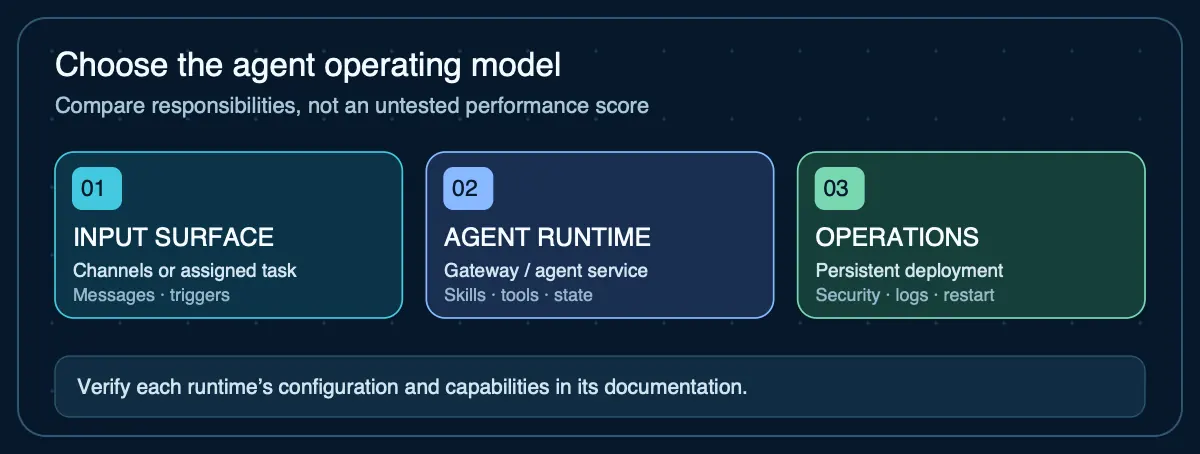
Can I build and host my own AI agent?
Yes. A self-hosted AI agent can run on your own computer, a home server, a VPS, or cloud infrastructure you control. The agent framework and the language model do not have to run on the same machine: self-hosted agents can call external model APIs when that is the better operational choice.
Can I build my own AI agent for free?
Open-source agent software eliminates software-license cost, but running an agent still consumes hardware, electricity, hosting, model inference, storage, or API resources. A useful cost comparison separates software price from ongoing infrastructure cost.
Self-Hosted Agent Framework Comparison
Two well-documented open-source agent runtimes illustrate the range of self-hosted approaches. A DIY stack built on LangChain, CrewAI, or similar libraries is a third path with different tradeoffs.
| Dimension | OpenClaw | Hermes Agent | DIY framework stack |
|---|---|---|---|
| Runtime language | TypeScript / Node.js | Python + TypeScript | Depends on framework |
| Platform support | macOS, Linux, Windows | macOS (Apple Silicon only) | Varies |
| Local model support | Via Ollama or compatible API | Built-in local inference | Depends on integration |
| Remote API support | Yes — OpenAI-compatible endpoints | Yes | Varies |
| Persistence model | Local database, loopback only | Local state and memory | You build it |
| License | MIT | MIT | Varies |
Capabilities from current first-party documentation. “DIY” column reflects the general case for custom agent stacks.
What Infrastructure Does a Self-Hosted Agent Need?
The answer splits into two workloads that can run together or separately:
Agent runtime (orchestration)
CPU, moderate RAM, persistent storage for state and logs, process supervision, network access to tools and APIs. A $5–24/mo VPS or a Mac mini is often sufficient when the model runs elsewhere.
Model inference (if colocated)
GPU or unified memory sized to the model and quantization. Adds significant cost and operational complexity compared to calling an API, but eliminates per-token charges and keeps data local.
Self-Hosted Agent Decision Checklist
Before committing to self-hosting, work through these questions:
- Does the agent need to run 24/7, or is on-demand sufficient?
- Will the model run locally or via an external API?
- What credentials and tools does the agent access, and how are they scoped?
- Who handles OS patches, runtime updates, backups, and recovery?
- How will you detect and investigate failures or unexpected agent behavior?
- Is the data sensitivity high enough to justify the operational overhead of self-hosting?
How to Compare Self-Hosted AI Agent Frameworks
- Where the agent runtime executes and what platforms it supports.
- How state and memory are persisted across restarts.
- How tools and credentials are authorized and scoped.
- Whether background jobs survive host restarts.
- How logs, approvals, and audit evidence are handled.
- Which infrastructure and model dependencies are required.
- How much ongoing maintenance the operator owns.
Sources
- OpenClaw — installation— Self-hosted agent runtime and deployment requirements
- Hermes Agent — installation— Local and Linux deployment requirements for Hermes Agent
- DigitalOcean Droplet pricing— Example infrastructure cost independent of agent software licensing
Agent Infrastructure Recommendation Kit
Turn your self-hosting decision into a documented infrastructure plan
The Recommendation Kit walks through framework selection, hardware sizing, hosting economics, security controls, and maintenance planning so you can defend the architecture to your team.
Get the Recommendation Kit — $19