Infrastructure comparison
Hermes Agent vs OpenClaw: Hosting, Models, Security and Automation
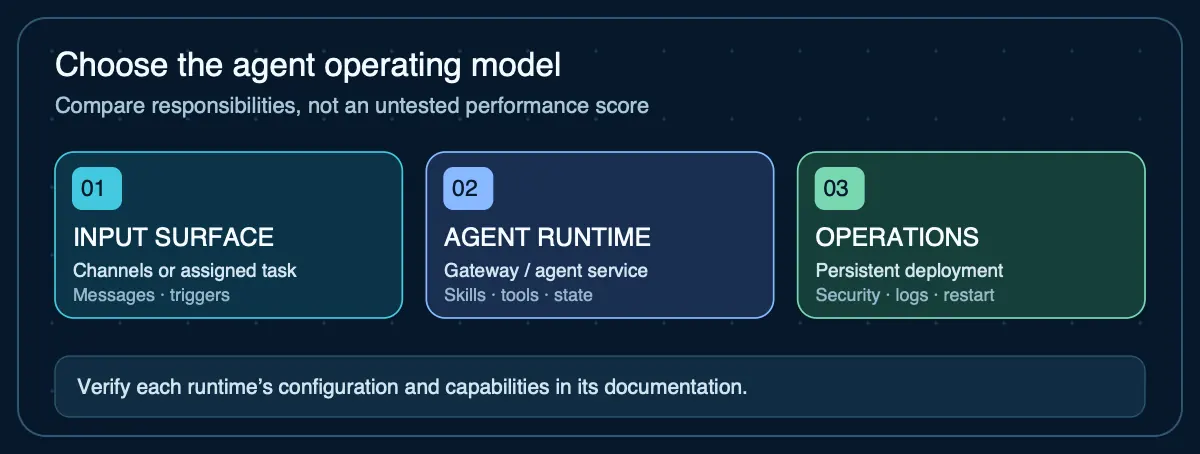
Hermes Agent and OpenClaw are both open-source, self-hosted, and MIT-licensed, but they solve different problems. OpenClaw is a messaging gateway that connects 32+ platforms to AI models. Hermes is an autonomous agent with a learning loop that creates skills from experience. The infrastructure decision depends on which operating model you need, not which project has more stars.
What Is OpenClaw?
OpenClaw is an open-source AI assistant gateway maintained by the OpenClaw Foundation, an independent 501(c)(3) nonprofit. It connects messaging platforms (Discord, Slack, Telegram, WhatsApp, iMessage, Signal, Matrix, and others) to AI model providers. OpenClaw has no paid tier and no hosted service — you run it on your own infrastructure. The gateway is written in TypeScript, runs on Node.js, and binds to loopback by default on port 18789.
What Is Hermes Agent?
Hermes Agent is an open-source, self-improving AI agent by Nous Research. It creates skills autonomously from experience, persists memory across sessions, and models the user over time. Hermes is primarily Python (~81%), with TypeScript used for browser automation and the WhatsApp bridge. It requires models with at least 64,000-token context for agentic work. Nous Research also offers Hermes Cloud as a paid hosted option.
Hermes vs OpenClaw: Infrastructure Comparison
| Dimension | OpenClaw | Hermes Agent |
|---|---|---|
| Primary use case | Messaging gateway connecting platforms to AI agents | Autonomous agent with learning loop and skill creation |
| Runtime | TypeScript on Node.js 24.16+ / 26.1+ | Python 3.11 + Node.js v26 (auto-provisioned) |
| License | MIT — OpenClaw Foundation (501(c)(3)) | MIT — Nous Research |
| macOS support | Yes (menu-bar app, LaunchAgent) | macOS 12+ Apple Silicon only (no Intel) |
| Linux support | Yes (systemd user service) | Debian/Ubuntu, Arch, Fedora/RHEL, openSUSE |
| Windows support | Native Hub app + WSL2 | Native + WSL2 |
| Mobile | iOS and Android apps | Android via Termux only |
| Docker | Official (Dockerfile, compose, Podman, Kubernetes) | docker-compose.yml included |
| Default network binding | Loopback only (port 18789) | Not documented |
| Security audit CLI | openclaw security audit | Not documented |
| Ollama support | Official provider with auto-discovery | Via custom endpoint + official guide |
| Context requirement | Not documented | 64,000 tokens minimum for agentic work |
| Messaging platforms | 32+ (bundled + plugins) | 15+ |
| MCP client | Not documented in pages checked | Since v0.2.0 (auto-registered tools) |
| Terminal backends | N/A (gateway model) | Local, Docker, SSH, Singularity, Modal |
| Persistence | ~/.openclaw/ (config, state) | ~/.hermes/ (config, SQLite DB, skills) |
| Learning | ClawHub registry, community skills | Autonomous skill creation, user modeling |
| VPS deployment guides | 8+ official (Hetzner, DO, GCP, Azure, Fly.io, Railway) | SSH/Docker backends documented |
| Cloud offering | None (self-hosted only) | Hermes Cloud (paid hosted agent) |
| Minimum RAM | Not documented | Not documented |
Which Differences Matter for Deployment?
If you need a messaging gateway: OpenClaw covers more platforms (32+ vs 15+), has more extensive VPS deployment documentation, and defaults to loopback binding with a security audit CLI. It is purpose-built to sit between messaging platforms and model providers.
If you need an autonomous agent that learns: Hermes creates skills from experience, persists memory with a SQLite-backed knowledge base, models users over time, and has 5 terminal backends (including Docker and SSH sandboxing). The 64,000-token context requirement constrains local model selection.
If macOS Intel matters: Hermes requires Apple Silicon. OpenClaw runs on both Intel and Apple Silicon.
If you want a hosted option: Hermes Cloud provides a paid always-on deployment. OpenClaw has no hosted service — self-hosting is the only option.
What AIG Has Not Measured Yet
The comparison table above uses documented project specifications. The following require hands-on testing with controlled infrastructure before AIG can publish comparative results:
- Idle RAM consumption of each agent
- RAM consumption under a representative workload (active conversation with tool use)
- CPU utilization at idle and under load
- Cold start time from process launch to first response
- Smallest VPS plan that successfully runs each agent
- Recovery behavior after process kill and host reboot
- Disk space consumed by a default installation
- Actual ports listening after default installation
- Whether OpenClaw and Hermes can coexist on the same VPS
Agent Infrastructure Recommendation Kit
Moving from comparison to infrastructure selection?
The Recommendation Kit helps you map framework requirements to specific hosting decisions — documenting workload characteristics, comparing deployment options, and recording the evidence behind your architecture choice.
Get the Recommendation Kit — $19Sources
- OpenClaw — Installation— Runtime, platform support, and deployment methods
- OpenClaw — Gateway Security— Network binding, authentication, and security audit
- OpenClaw GitHub Repository— Source code, language composition, and Docker configuration
- Hermes Agent — Installation— Runtime, platform support, and installation methods
- Hermes Agent — Terminal Backends— Docker, SSH, Singularity, and Modal execution backends
- Hermes Agent GitHub Repository— Source code, language composition, and Docker configuration