01
Discover
Capture workload, privacy, uptime, budget and operational constraints before comparing products.
Agent Infrastructure Recommendation Kit
Use a repeatable six-step system to size the workload, compare local vs. cloud options, document the evidence, and produce a recommendation you can defend before you commit to hardware or hosting.
One-time $19 purchase · editable templates and PDFs · delivered through Whop
Know what you are buying
Five editable DOCX worksheets, matching PDF versions, and a Start Here guide. These are decision-making templates, not a hosted app or a promise that one provider fits every workload.
Worksheet 1
Record the workload, privacy constraints, uptime, ownership and unknowns.
Worksheet 2
Keep model, context, memory and concurrency assumptions visible.
Worksheet 3
Compare local, VPS, GPU cloud and hybrid candidates against the same requirements.
Worksheet 4
Separate provider statements from calculations, measurements and unresolved claims.
Worksheet 5
Document the selected option, fallback, risks and next validation actions.
Illustrative example of how the worksheets connect; not a measured benchmark or a real client result.
REQ-001: Agent must be available continuously. → CAP-001: Estimate memory and uptime needs. → DEC-001: Compare viable hosting options. → EVD-001: Record which claims still need verification.
This is the difference between a provider list and a decision record that can be revisited when requirements change.
The expensive mistake is not choosing the second-best GPU. It is buying infrastructure before the workload, memory requirement, operating constraints and evidence are clear.
The Kit turns scattered research into one auditable workflow. It is designed for people making real deployment or purchasing decisions—not for generating a generic “best server” answer.
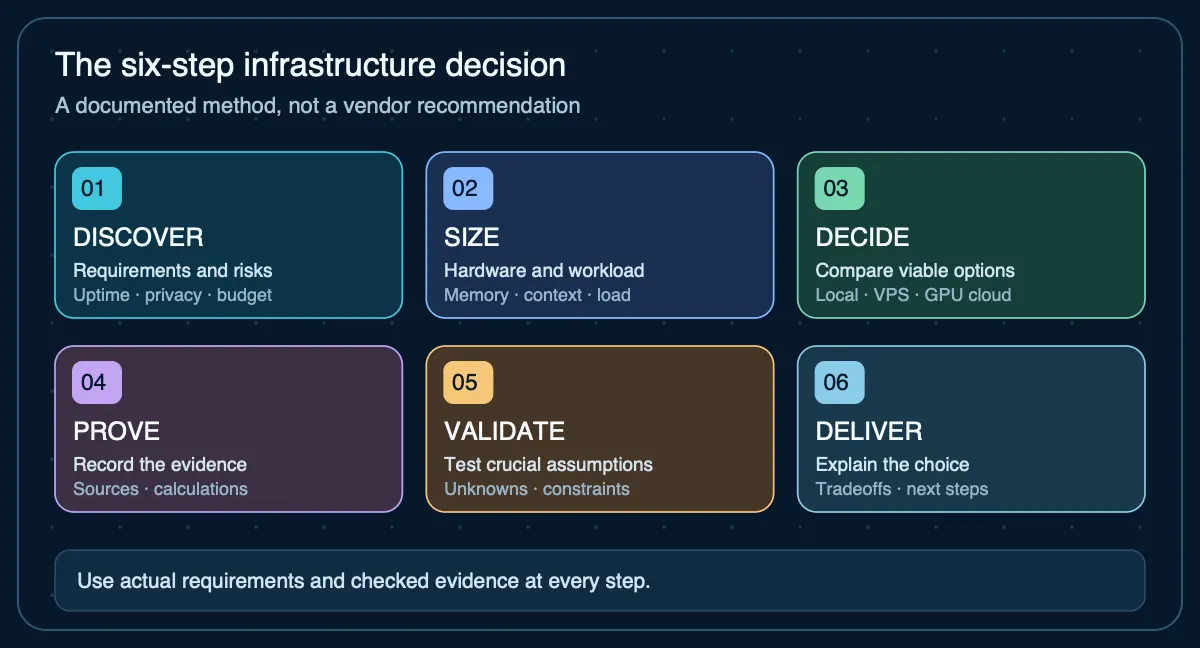
The six-step method
01
Capture workload, privacy, uptime, budget and operational constraints before comparing products.
02
Turn model, memory, context and concurrency assumptions into explicit capacity requirements.
03
Compare local hardware, VPS, GPU cloud and hybrid architectures against the same requirements.
04
Separate verified facts, calculations, vendor claims and unknowns in an evidence ledger.
05
Check the assumptions that could make the recommendation fail before money is committed.
06
Turn the work into a clear recommendation that records tradeoffs, alternatives and next steps.
Builders, consultants, technical buyers and teams deciding how an AI workload should run—and anyone who needs to explain why that architecture was chosen.
It does not invent benchmarks, pretend vendor claims are independent evidence, or give one universal “best” architecture. The method keeps assumptions and uncertainty visible.
Use the free calculators to answer individual questions; use the Kit when the individual answers need to become one infrastructure decision.
Work through the same requirements, sizing, comparison and evidence process every time—then keep the reasoning with the recommendation.