Agent security
Best AI Agent Security Tools: Identity, Sandboxing, MCP and Runtime Controls
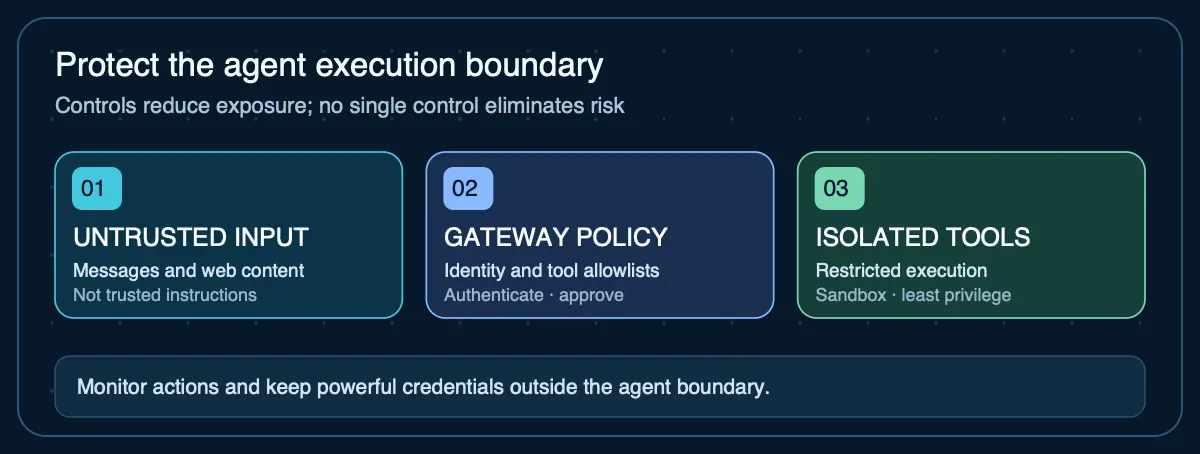
An AI agent can combine model output with credentials, tools, networks, code execution, memory, and external data. Security has to control what the agent can actually do, not only filter what it says.
Are AI agents a security risk?
They can be. The risk comes from combining model-generated decisions with real authority over tools, files, credentials, browsers, APIs, and external systems. The security problem is broader than prompt filtering — it includes tool misuse, privilege escalation, supply-chain compromise, and unbounded resource consumption.
Can AI agents be trusted?
Trust should come from constrained authority, verification, monitoring, testing, and recovery controls rather than an assumption that the model will always behave correctly. High-impact actions should have stronger safeguards than low-risk read-only tasks.
Screen access creates a data boundary even when a tool only gives instructions. Our Guidy AI privacy evaluation shows the retention, external-processing, and masking questions to ask before an on-screen assistant sees confidential work.
OWASP Agentic AI Risks and Corresponding Controls
The OWASP Top 10 for Agentic Applications 2026 identifies specific risk categories for AI agents. The table below maps each risk to the control category that addresses it:
| OWASP risk | Control category | Ref |
|---|---|---|
| Goal and instruction hijacking | Input validation, instruction boundaries, output verification | AG01 |
| Tool misuse and unintended actions | Tool authorization policies, destructive-action gates, scope limits | AG02 |
| Identity and privilege abuse | Per-agent identity, least privilege, credential rotation | AG03 |
| Agentic supply-chain compromise | Plugin/tool vetting, dependency auditing, MCP server verification | AG04 |
| Unexpected code execution | Sandboxing, filesystem and network isolation, execution allow-lists | AG05 |
| Memory and context poisoning | Context integrity, memory validation, untrusted-data boundaries | AG06 |
| Unbounded resource consumption | Rate limiting, cost caps, loop detection, timeout enforcement | AG07 |
Risk categories from the OWASP Top 10 for Agentic Applications 2026. Reference codes are for navigation within the OWASP document.
Core AI Agent Security Controls
Identity and least privilege
Give each agent or workload only the credentials and permissions required for its current role. Avoid silently inheriting broad operator privileges. Where possible, use short-lived tokens scoped to the specific tools and data the agent needs for one task.
Tool authorization
Tool availability does not mean every invocation should be allowed. Destructive, financial, external-communication, or high-impact actions should have explicit policy boundaries. Consider separating the list of tools the agent can discover from the subset it can invoke without approval.
Sandboxing
Shell, browser, code execution, and untrusted files should execute inside boundaries that limit filesystem, process, credential, and network access. The goal is to contain blast radius — if the agent does something unexpected, the damage is bounded.
Human approval
Human approval is most useful at meaningful authority boundaries, not as a flood of low-risk confirmations that operators eventually ignore. Design approval workflows around the actions where a mistake is costly or irreversible.
Audit and runtime monitoring
Preserve tool calls, authorization decisions, failures, approvals, and resulting changes so unexpected behavior can be investigated. Audit logs should be immutable and retained long enough for incident review.
Security Checklist for Agent Deployments
- Does each agent have its own identity, or does it share the operator's credentials?
- Can the agent access credentials or data beyond what the current task requires?
- Are destructive or high-cost actions gated behind approval or policy?
- Is code execution sandboxed with filesystem and network boundaries?
- Are tool calls and authorization decisions logged immutably?
- Is there a cost cap or loop-detection mechanism to prevent runaway resource consumption?
- Are MCP servers, plugins, and tool dependencies audited before deployment?
How AI Agent Security Tools Should Be Compared
Security products should not be ranked from feature lists alone. Future testing will examine whether controls actually prevent unauthorized tool use, privilege widening, unsafe shell execution, credential exposure, prompt-injection escalation, and unaudited state changes.
Sources
- OWASP Top 10 for Agentic Applications 2026— Current agentic risk framework covering goal hijacking, tool misuse, identity and privilege abuse, supply-chain risk, unexpected code execution and related controls
- Microsoft — Secure agents— Agent identity, least privilege, data protection and monitoring guidance
Agent Infrastructure Recommendation Kit
Build a security plan for your agent deployment
The Recommendation Kit includes a security controls checklist aligned with OWASP agentic risks so you can evaluate your agent architecture against each risk category and document mitigation decisions.
Get the Recommendation Kit — $19