Agent operations
Best AI Agent Observability Tools: Tracing, Evals and Runtime Monitoring
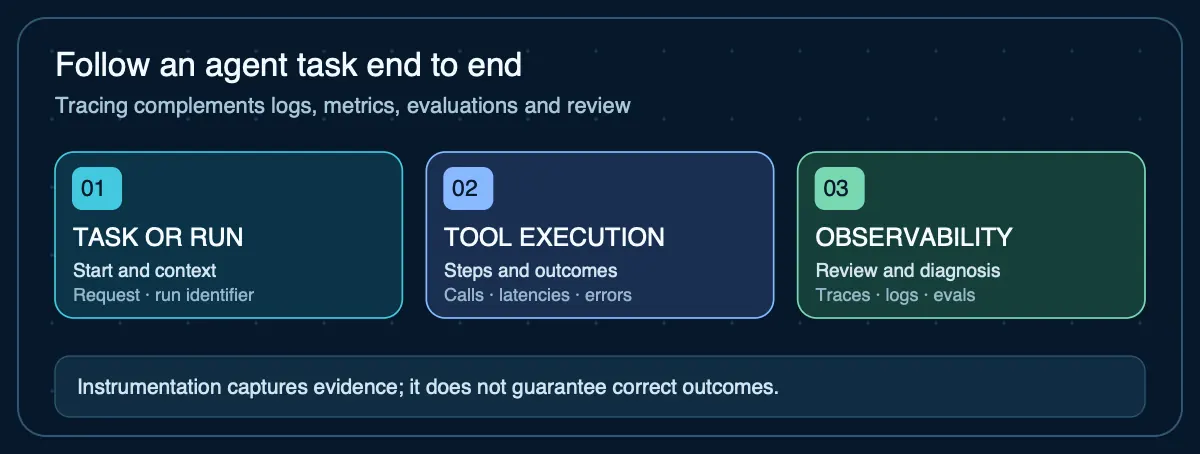
Agent observability has to explain more than whether an application is online. A useful system should reconstruct the path from request to model decision to tool call to downstream effect — and help you detect when that path goes wrong before users do.
What is AI agent observability?
AI agent observability is the ability to reconstruct what an agent did, why a task failed, which model and tools were involved, how long each step took, and what downstream systems changed as a result. It goes beyond traditional APM because agent behavior is non-deterministic — the same input can produce different tool sequences, and failure modes include correct execution of the wrong plan.
How do you monitor an AI agent?
Useful monitoring combines traces, logs, metrics, tool-call history, model telemetry, task state, failures, retries, and evaluation results. Infrastructure uptime alone cannot explain whether the agent completed the right task safely.
What an AI Agent Observability Stack Should Capture
Distributed tracing
Follow one task across the agent runtime, model calls, MCP servers, tools, queues, and downstream services.
Tool-call visibility
Record which tool was selected, inputs, outputs, latency, errors, retries, and resulting state changes.
Model telemetry
Track model/provider, latency, token usage, failures, and cost where the provider exposes those signals.
Evaluation
Compare agent outputs and trajectories against expected behavior rather than relying on uptime alone.
Logs and metrics
Connect agent-specific traces to standard infrastructure logs, resource metrics, and error monitoring.
Audit evidence
Preserve enough execution history to explain what the agent did after a failure or unexpected action.
How to Select an Agent Observability Tool
Use these criteria to evaluate observability platforms against your agent architecture and operational requirements:
| Criterion | Key question |
|---|---|
| OpenTelemetry support | Can you send traces via OTel, or are you locked into a proprietary collector? |
| LLM-aware spans | Does the platform understand model calls, token counts, and tool invocations as first-class span types? |
| Evaluation framework | Can you define expected agent behavior and compare it to actual trajectories? |
| Retention and search | How long are traces stored, and can you search by tool name, error type, or model? |
| Alerting | Can you trigger alerts on failure rate, latency, cost anomalies, or evaluation regressions? |
| Cost | What is the pricing model — per-span, per-seat, per-GB, or tiered? |
OpenTelemetry for AI Agent Observability
OpenTelemetry provides standard traces, metrics, logs, and context propagation. For agent systems, it serves as the transport layer beneath specialized LLM or agent dashboards rather than forcing every component into a proprietary telemetry format. The current MCP specification supports W3C Trace Context propagation, so an MCP tool call can participate in a broader distributed trace across the agent, gateway, MCP server, and downstream services.
Distributed Tracing for AI Agents and Tool Calls
A trace should connect the original task with model calls, queues, MCP calls, external APIs, and other services. That is more useful for debugging than isolated logs with no shared execution context. When evaluating a tracing solution, test whether it can reconstruct an end-to-end agent task — not just individual HTTP calls — and whether the resulting timeline is searchable by tool name, error type, or model provider.
Agent Observability Anti-Patterns
- Monitoring only uptime when the real failure mode is “agent is running but doing the wrong thing.”
- Logging prompts and responses without structured tool-call traces.
- Alerting on token cost without correlating it to task completion rate.
- Storing evaluation results that are never reviewed or acted on.
How AI Agent Observability Tools Should Be Compared
Specific observability products will be ranked after the same agent workload is instrumented across competing platforms. Important tests include setup time, trace completeness, searchability, retention, evaluation support, OpenTelemetry interoperability, and cost.
Sources
- OpenTelemetry documentation— Traces, metrics, logs and vendor-neutral telemetry
- OpenTelemetry — Context propagation— Correlation of distributed operations across service boundaries
- OpenTelemetry — Traces— Distributed traces, spans and causal execution context
- MCP 2026-07-28 specification — tracing— W3C Trace Context propagation across MCP hosts, SDKs, and servers
Agent Infrastructure Recommendation Kit
Build an observability plan for your agent stack
The Recommendation Kit includes an observability requirements checklist covering tracing, evaluation, alerting, and retention so you can evaluate platforms against your agent architecture.
Get the Recommendation Kit — $19