Mistral infrastructure
Mistral Hardware Requirements: RAM and VRAM for 7B and 24B Models
Mistral's open models span the classic 7B class and newer 24B models aimed at stronger local and single-GPU deployments. The sizing below uses the official parameter counts and keeps raw weight floors separate from deployment headroom.
Mistral hardware requirements: quick answer
Mistral 7B starts around a 3.5 GB 4-bit weight floor. Mistral Small 24B starts around 12 GB at 4-bit before cache and runtime reserves; Mistral's own model card describes the 24B instruct model as suitable for a single RTX 4090 or a 32 GB RAM Mac when quantized.
Computed RAM / VRAM floors by model
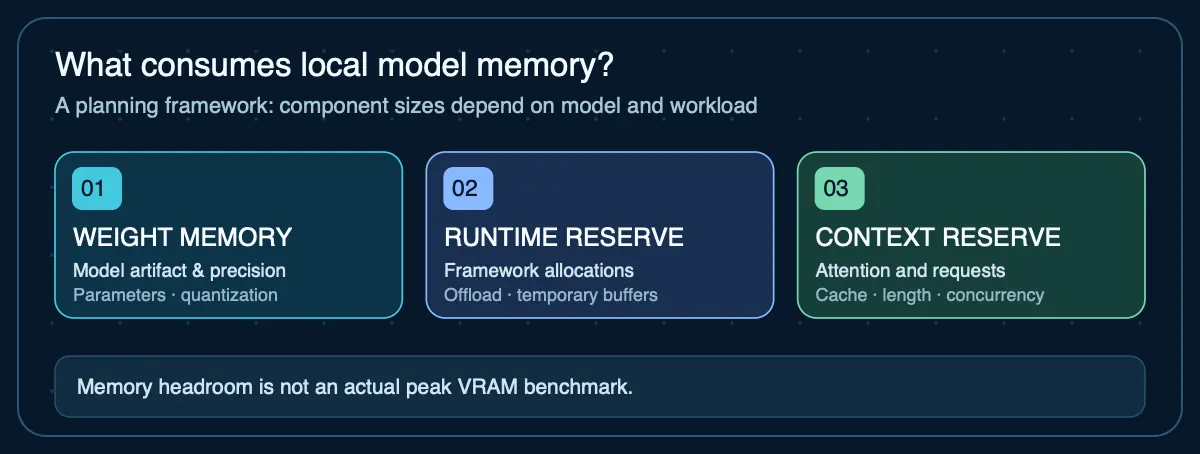
Weight memory is parameter count × bits per weight ÷ 8. The final column is deliberately more conservative: it runs the same 4-bit estimate through AIG's default 20% runtime reserve and 2 GB context/cache reserve. Neither value includes workload-specific concurrency, unusually long context, offload buffers, or multimodal activations.
| Model | 16-bit floor | 8-bit floor | 4-bit floor | 4-bit planning target |
|---|---|---|---|---|
Mistral 7B v0.3 7B parameters | 14 GB | 7 GB | 3.5 GB | 6.2 GB |
Mistral Small 24B 24B parameters | 48 GB | 24 GB | 12 GB | 16.4 GB |
CALCULATED. The planning target is weight floor + 20% runtime reserve + 2 GB context reserve. Validate the actual artifact and runtime before buying hardware.
Recalculate Mistral for your quantization and reserves
Starts with 24B parameters. Change precision, runtime reserve or context reserve to match your deployment.
Why context reserve is manual: exact attention-cache memory cannot be inferred safely from parameter count alone. For a real deployment, measure the specific model and runtime at the context length and batch size you intend to use.
Your next step
This estimate exceeds a base 16 GB configuration. Compare larger Mac memory tiers and leave space for macOS and runtime overhead before deciding.
Compare Macs that reach this much memory →Open the full RAM and VRAM calculator → for the method, the caveats, and how it differs from the artifact-based compatibility checker.
What changes for Mistral
Artifact size is often a better final check than the raw parameter formula. Mistral 7B's published BF16 safetensors are roughly 14.5 GB, while Mistral Small 24B's consolidated BF16 weights are roughly 47.1 GB; quantized files are smaller and format-dependent.
Weight fit is not the same as deployment fit
- Check the exact GGUF, safetensors, AWQ, GPTQ or runtime-specific artifact you will load.
- Reserve memory for KV cache, runtime allocations, the operating system and concurrent requests.
- Unified-memory Macs share the same pool with the OS and applications; discrete-GPU systems still need system RAM.
- For MoE models, active parameters reduce compute per token but do not automatically remove inactive expert weights from memory.
Sources
- Mistral 7B v0.3 model card— Official 7B checkpoint and model files
- Mistral Small 24B model card— 24B parameter count and local deployment guidance
Agent Infrastructure Recommendation Kit
Sizing infrastructure for Mistral?
Use the Agent Infrastructure Recommendation Kit to carry these memory assumptions into a documented local-vs-cloud infrastructure decision with explicit evidence and verification steps.
Get the Recommendation Kit — $19