DeepSeek infrastructure
DeepSeek Hardware Requirements: RAM and VRAM by Model Size
DeepSeek spans small distilled models that can run locally and a 684B full R1 model that belongs in multi-GPU or heavily offloaded deployments. This page sizes the weights from official model-card parameter counts, then adds the same explicit planning reserves used by the AIG VRAM calculator.
DeepSeek hardware requirements: quick answer
For local DeepSeek use, the R1 distills are the practical starting point. A 14B distill has a 7 GB 4-bit weight floor before runtime and context reserves; a 32B distill starts at 16 GB. The full 684B R1 is a completely different infrastructure class.
Computed RAM / VRAM floors by model
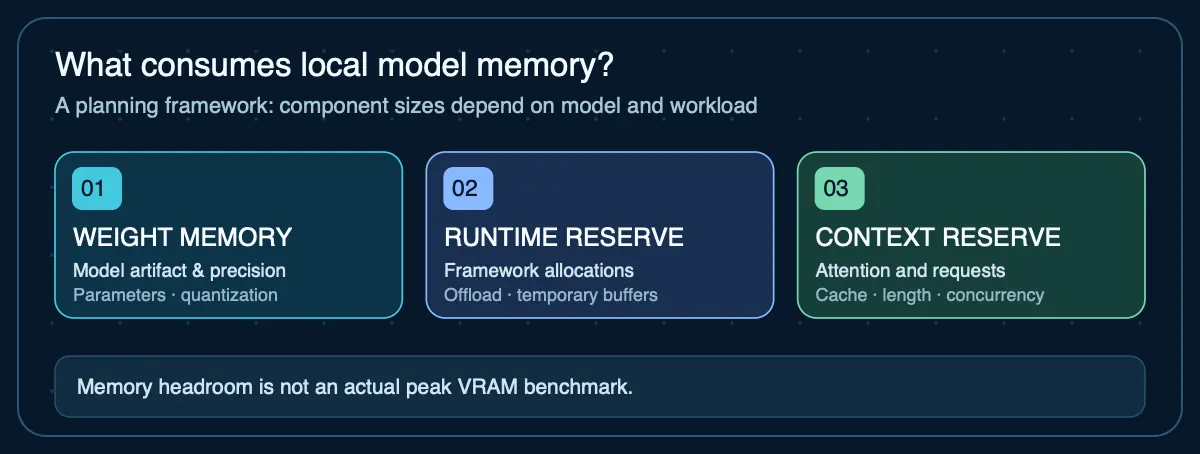
Weight memory is parameter count × bits per weight ÷ 8. The final column is deliberately more conservative: it runs the same 4-bit estimate through AIG's default 20% runtime reserve and 2 GB context/cache reserve. Neither value includes workload-specific concurrency, unusually long context, offload buffers, or multimodal activations.
| Model | 16-bit floor | 8-bit floor | 4-bit floor | 4-bit planning target |
|---|---|---|---|---|
DeepSeek-R1-Distill-Qwen-1.5B 1.5B parameters | 3 GB | 1.5 GB | 0.8 GB | 2.9 GB |
DeepSeek-R1-Distill-Qwen-7B 7B parameters | 14 GB | 7 GB | 3.5 GB | 6.2 GB |
DeepSeek-R1-Distill-Qwen-14B 14B parameters | 28 GB | 14 GB | 7 GB | 10.4 GB |
DeepSeek-R1-Distill-Qwen-32B 32B parameters | 64 GB | 32 GB | 16 GB | 21.2 GB |
DeepSeek-R1-Distill-Llama-70B 70B parameters | 140 GB | 70 GB | 35 GB | 44 GB |
DeepSeek-R1 684B parameters · Full model; plan for sharding, offload, or multi-GPU infrastructure. | 1368 GB | 684 GB | 342 GB | 412.4 GB |
CALCULATED. The planning target is weight floor + 20% runtime reserve + 2 GB context reserve. Validate the actual artifact and runtime before buying hardware.
Recalculate DeepSeek for your quantization and reserves
Starts with 14B parameters. Change precision, runtime reserve or context reserve to match your deployment.
Why context reserve is manual: exact attention-cache memory cannot be inferred safely from parameter count alone. For a real deployment, measure the specific model and runtime at the context length and batch size you intend to use.
Your next step
This planning estimate is within a base Mac mini's advertised memory tier, but real quantized files, cache and macOS usage may still prevent the model from fitting. Check the exact configuration.
Check this against a Mac mini configuration →Open the full RAM and VRAM calculator → for the method, the caveats, and how it differs from the artifact-based compatibility checker.
What changes for DeepSeek
The distill checkpoints are separate dense models based on Qwen or Llama foundations. Do not size a distill from the 684B full-model count. Conversely, the full R1 model must be sized from its total parameter footprint rather than the much smaller amount of compute active during any one operation.
Weight fit is not the same as deployment fit
- Check the exact GGUF, safetensors, AWQ, GPTQ or runtime-specific artifact you will load.
- Reserve memory for KV cache, runtime allocations, the operating system and concurrent requests.
- Unified-memory Macs share the same pool with the OS and applications; discrete-GPU systems still need system RAM.
- For MoE models, active parameters reduce compute per token but do not automatically remove inactive expert weights from memory.
Sources
- DeepSeek-R1 official model card— 684B full model and the 1.5B, 7B, 8B, 14B, 32B and 70B distill lineup
Agent Infrastructure Recommendation Kit
Sizing infrastructure for DeepSeek?
Use the Agent Infrastructure Recommendation Kit to carry these memory assumptions into a documented local-vs-cloud infrastructure decision with explicit evidence and verification steps.
Get the Recommendation Kit — $19