API-backed agent operating 24/7
Start with a CPU VPS
The LLM runs at an external API; size CPU, RAM, browser workers, queues and recovery first.
AI server infrastructure
An AI dedicated server is a physical server reserved for one customer and configured to run AI workloads such as agents, model inference, training, vector databases, automation workers, or related services. Unlike a normal VPS, you control the server's full CPU, RAM, storage, networking, and any installed GPUs instead of sharing the underlying machine with other tenants.
Choose a dedicated AI server when you need persistent, predictable access to an entire physical host and its CPU, RAM, storage, networking, or GPUs. For API-backed agents, a VPS is often sufficient. Dedicated hardware becomes more compelling for steady local inference, private workloads, fixed GPU capacity, custom system requirements, or sustained utilization where on-demand infrastructure is a poor operational fit.
Compare deployment use cases, or compare current rentals? See current dedicated GPU server prices from Hetzner, Liquid Web and Latitude.sh.
Choose architecture from the workload, not the word “AI.” These are conditional planning examples, not performance benchmarks or universal minimum specifications.
Start with a CPU VPS
The LLM runs at an external API; size CPU, RAM, browser workers, queues and recovery first.
Compare hourly GPU cloud
If GPU-active hours are low, fixed dedicated rent may pay for long idle periods.
Compare dedicated GPU servers
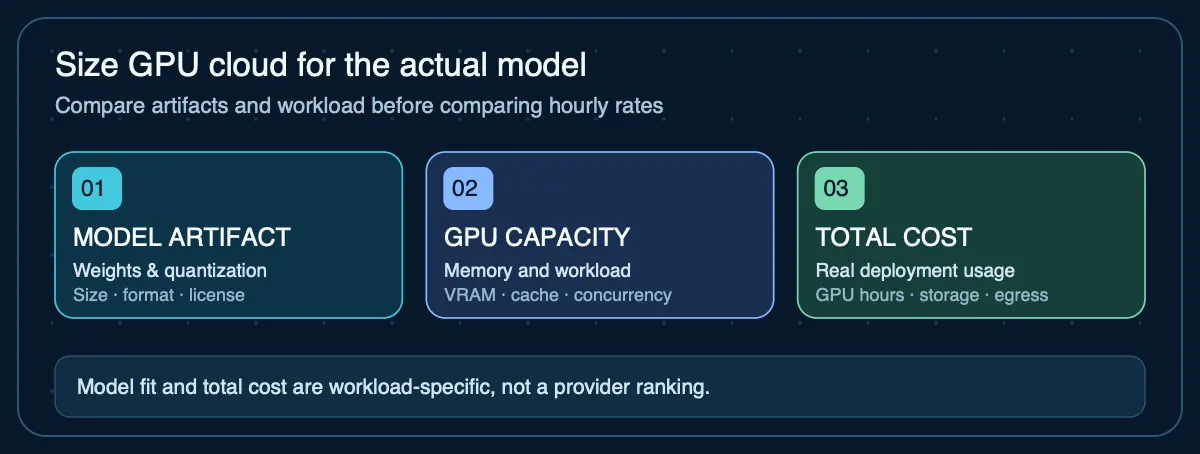
Validate model weights, runtime VRAM, context/KV cache, sustained concurrency and privacy requirements.
Validate a supported multi-GPU architecture
GPU memory is not automatically pooled. Verify interconnect, sharding, bandwidth and actual performance.
Not sure what hardware is required? Use the free Dedicated Server Advisor to generate an explicit memory envelope and compare your own quotes.
Interactive decision tool · illustrative starting values
Enter actual quotes and the number of GPU-active hours you expect in a month. This screens the fixed rent against usage-based GPU hours; the initial values are examples, not provider quotes. Only compare options with equivalent GPU performance, VRAM, service level and workload capability.
Scenario comparison · USD / month
Dedicated server
$850
On-demand GPU cloud
$350
On-demand GPU costs $500 less per month
Illustrative break-even: 486 GPU-active hours/month. This is a cost crossover, not a hardware recommendation.
Assumptions: dedicated monthly cost = rent + recurring extras; cloud monthly cost = GPU hourly rate × active hours + fixed extras. Setup fees, taxes, reserved discounts, storage transfers and operational constraints must be included manually in your quote. These results are neither price forecasts nor workload benchmarks.
For teaching purposes, assume $850/month dedicated rent versus $1.75/GPU-hour for identical GPU-equivalent capacity with no extras. These are illustrative inputs, not verified provider offers. Your quote may include different hardware, disks, power, egress, and support.
| Use case | GPU hours | Cloud monthly | Dedicated monthly | Lower cost |
|---|---|---|---|---|
| Occasional experiments | 80 | $140.00 | $850.00 | Hourly cloud |
| Part-time inference | 200 | $350.00 | $850.00 | Hourly cloud |
| Near-continuous inference | 650 | $1137.50 | $850.00 | Dedicated |
Arithmetic: hourly price × billed GPU hours + cloud extras versus fixed rent + dedicated extras. The break-even in this hypothetical comparison is 486 GPU hours/month. This is not a forecast or a recommendation without performance and availability verification.
The dedicated part describes hardware tenancy, not a special class of AI computer. The machine becomes an AI server when its hardware and software are sized for AI workloads. A CPU-only dedicated server can run API-based agents and orchestration. A GPU-equipped server can also run local model inference or training when the accelerator, memory, power, cooling, and PCIe layout fit the workload.
| Option | Infrastructure | Best fit | Main tradeoff |
|---|---|---|---|
| CPU VPS | Virtual machine on shared physical infrastructure | API-based agents, orchestration, webhooks, queues and light services | Limited local-model capacity and less hardware control |
| AI dedicated server | Entire physical server reserved for one customer | Persistent agents, private inference, fixed workloads and custom hardware | More operations work and usually a larger fixed commitment |
| GPU cloud | Rented accelerator capacity, often billed by usage | Burst training, experiments, variable inference and short-lived GPU jobs | Availability and effective cost can change with GPU type and runtime |
| Local AI workstation/server | Hardware you own and operate | Privacy, repeat local inference and workloads with predictable utilization | Up-front hardware, power, cooling, maintenance and remote-access planning |
A dedicated server starts to make sense when the workload is persistent enough that fixed capacity is useful, when you need predictable access to the same hardware, or when security and operational requirements justify greater isolation and control.
No. If your agents call OpenAI, Anthropic, Google, or another remote model API, the server may only need CPU, RAM, storage, and networking. A GPU is mainly required when the same machine performs local inference, training, embeddings at higher throughput, image/video generation, or another accelerated workload.
There is no universal AI-server minimum. For local inference, first determine the exact model artifact, precision or quantization, context length, runtime, and concurrency. VRAM must cover the accelerated workload; system RAM must also cover the OS, containers, databases, browsers, model loading or offload, and operating headroom. Use the RAM and VRAM calculator as a planning estimate, then validate the actual runtime before buying hardware.
Renting dedicated hardware shifts the up-front purchase to a recurring infrastructure bill and usually puts the machine in a data center. Owning a server gives you the hardware asset and local control, but you also own power, cooling, connectivity, physical maintenance, and replacement. Compare both on total cost and operational requirements, not hardware price alone. If ownership is the goal, use the build-your-own AI server guide.
| Component | What to size for | Common mistake |
|---|---|---|
| CPU | Agent workers, preprocessing, databases, browser tasks, tokenization and feeding GPUs. | Buying a fast GPU while under-sizing the rest of the system. |
| System RAM | Model loading, CPU offload, databases, containers, browsers and workload headroom. | Sizing RAM only for the model and ignoring the operating stack. |
| GPU / VRAM | Model weights, quantization, context, batching, concurrency and training state. | Choosing by GPU name instead of whether the workload fits in memory. |
| Storage | Model files, container images, databases, logs, checkpoints and backups. | Filling the boot disk with model caches and leaving no recovery headroom. |
| Networking | API traffic, downloads, remote storage, users, multi-node traffic and administration. | Ignoring bandwidth limits, latency, firewalling, or remote-management needs. |
There is no useful single price because a CPU-only automation server and a multi-GPU training server are fundamentally different purchases. For a rented server, compare the base machine, GPU premium, RAM, NVMe storage, bandwidth, backups, IP addresses, management, and contract term. For owned hardware, add purchase price, power, cooling, networking, replacement risk, and the time required to maintain the machine.
These are dated first-party prices for single-tenant (bare-metal) GPU servers, from the entry-level inference tier to a full H100. They are not performance rankings. Hourly plans are also shown as an always-on month (730 hours) so they compare with monthly plans; that column is our arithmetic, not a provider quote.
| Provider | Server | GPU / VRAM | System RAM | Published price | Always-on month | Source |
|---|---|---|---|---|---|---|
| Hetzner | GEX45 | NVIDIA RTX PRO 4000 Blackwell SFF · 24 GB | 64 GB | $249.00/month | $249 | View serverPrice source Data checked 2026-10-03 · Source: Hetzner Dedicated root server, 2× 512 GB NVMe. $249/month plus a one-time $249 setup fee (€214/month, €209 setup), prices without VAT. Locations in Germany and Finland. |
| Liquid Web | L4 Ada 24GB | NVIDIA L4 · 24 GB | 128 GB | $0.80/hour | $584 | Official pricing Data checked 2026-10-03 · Source: Liquid Web Single-tenant bare-metal server, 1.92 TB NVMe RAID-1. Shown as 25% off $1.07/hr; verify the current rate at checkout. |
| Liquid Web | L40S Ada 48GB | NVIDIA L40S · 48 GB | 256 GB | $1.44/hour | $1,051 | Official pricing Data checked 2026-10-03 · Source: Liquid Web Single-tenant bare-metal server, 3.84 TB NVMe RAID-1. Shown as 25% off $1.92/hr; verify the current rate at checkout. |
| Latitude.sh | g3.h100.small | NVIDIA H100 80GB · 80 GB | — | $1.68/hour | $1,226 | Official pricing Data checked 2026-10-03 · Source: Latitude.sh Bare-metal GPU server, 2× 3.8 TB NVMe. Listed as starting at $1.68/hr or $1,230/month. |
| Liquid Web | H100 NVL 94GB | NVIDIA H100 NVL · 94 GB | 256 GB | $2.98/hour | $2,175 | Official pricing Data checked 2026-10-03 · Source: Liquid Web Single-tenant bare-metal server, 3.84 TB NVMe RAID-1. Shown as 25% off $3.97/hr; verify the current rate at checkout. |
Do not buy or rent dedicated hardware just because the workload uses AI. A normal VPS is usually simpler for an API-based agent with modest resource needs. GPU cloud can be better for short experiments or burst workloads, while a local machine can be more economical when you already own suitable hardware and can tolerate managing it yourself.
Agent Infrastructure Recommendation Kit
The Agent Infrastructure Recommendation Kit turns workload requirements, sizing assumptions, costs, and evidence into a documented infrastructure comparison before you commit to hardware.
Get the Recommendation Kit — $19